7. Algebra for infinite words
Recall that a monoid consists of a universe  together with a product operation
![\[\pi : M^* \to M\]](https://www.mimuw.edu.pl/~bojan/wp-content/ql-cache/quicklatex.com-05c6da477cf51b02ead6189190303389_l3.png "Rendered by QuickLaTeX.com")
which maps each one letter word  to , and which is associative in the sense that the following diagram commutes
![\[\xymatrix{(M^*)^* \ar[r]^{flat} \ar[d]_{\pi^*} & M^* \ar[d]^\pi \\ M^* \ar[r]_\pi & M}\]](https://www.mimuw.edu.pl/~bojan/wp-content/ql-cache/quicklatex.com-3d85961c181c602eea860017ed60428d_l3.png "Rendered by QuickLaTeX.com")
where  flattens a word of words into a word in the obvious way, while
  applies the product operation to every word in a word of words.
To define monoids for infinite words, we use the same definition, only  is replaced by
  . This requires a new flattening operation
![\[\mathrm{flat} : (M^\infty)^\infty \to M^\infty\]](https://www.mimuw.edu.pl/~bojan/wp-content/ql-cache/quicklatex.com-7de29c135036f5d7edb9ea6e8c4cc8a3_l3.png "Rendered by QuickLaTeX.com")
which we illustrate on three examples:
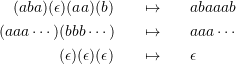
Note how in the second example above, the first infinite word causes the rest of the input to be ignored. This ignoring is a little bit of a hack, which could be avoided by either using two sorts (finite and infinite word), or by considering a richer notion of words which is closed under substitution, e.g. words where the positions form a countable well-ordering.
Summing up, -monoids are defined below.
Definition. An -monoid consists of a unierse together with a product operation
![\[\pi : M^\infty \to M\]](https://www.mimuw.edu.pl/~bojan/wp-content/ql-cache/quicklatex.com-0587f1f7646f34b5d21ddabf348e429f_l3.png "Rendered by QuickLaTeX.com")
which is the identity on one letter words and which is associative in the sense that the following diagram commutes
![\[\xymatrix{(M^\infty)^\infty \ar[r]^{flat} \ar[d]_{\pi^\infty} & M^\infty \ar[d]^\pi \\ M^\infty \ar[r]_\pi & M}\]](https://www.mimuw.edu.pl/~bojan/wp-content/ql-cache/quicklatex.com-6d73dddb37c382bce083ec99314a3ee6_l3.png "Rendered by QuickLaTeX.com")
It is not difficult to see that  , with flattening as the monoid operation, is an -monoid. Here is an example of an -monoid with a finite universe.
Example. This -monoid is going to recognize the -words over alphabet  which contain infinitely many
  ‘s. The universe is
![\[M = \set{\epsilon, a, b, a^\omega, b^\omega}\]](https://www.mimuw.edu.pl/~bojan/wp-content/ql-cache/quicklatex.com-5a2342b38c8323c68824e24c70213cac_l3.png "Rendered by QuickLaTeX.com")
The product operation is defined as follows. To define  with
with  , we do the following. First, remove all
  letters from
  . If the result is empty, return . If there is a letter of the form
  or
or  , then return the or , whichever comes first in . Otherwise, if the result is an infinite word, then return if there are infinitely many ‘s and otherwise. Otherwise, return if there is at least one and
  otherwise.
Homomorphism. Define a homomorphism of -monoids and  to be a function
  between their universes which respects the structure of -morphisms in the sense that the following diagram commutes
![\[\xymatrix{M^\infty \ar[r]^{h^\infty} \ar[d]_{\pi_M} & N^\infty \ar[d]^{\pi_N} \\ M \ar[r]^h & N}\]](https://www.mimuw.edu.pl/~bojan/wp-content/ql-cache/quicklatex.com-e8c3a6f116e64797611530a400555694_l3.png "Rendered by QuickLaTeX.com")
Compositional functions. As with normal monoids, instead of defining an associative product operation on a universe , it is sometimes easier to give a compositional function from an existing -monoid to , and get the -monoid structure on automatically from that. We describe this now. Suppose that is an -monoid and is a set. A function
![\[h : M \to N\]](https://www.mimuw.edu.pl/~bojan/wp-content/ql-cache/quicklatex.com-be18c2b3a150fe23974498a73045586e_l3.png "Rendered by QuickLaTeX.com")
is called compositional if every words  satisfy
![\[h^\infty(w) = h^\infty(v) \qquad \text{implies} \qquad h(\pi(w)) = h(\pi(v))\]](https://www.mimuw.edu.pl/~bojan/wp-content/ql-cache/quicklatex.com-738feaa62feed90c2cab2f652a338726_l3.png "Rendered by QuickLaTeX.com")
Lemma. If  is compositional, then there is a multiplication operation on which turns it into an -monoid, and which turns into a homomorphism of -monoids.
Proof. Compositionality can be rephrased as saying that there is some function  which makes the following diagram commute
![\[\xymatrix{M^\infty \ar[r]^{h^\infty} \ar[d]_{\pi} & N^\infty \ar[d]^\sigma \\ M \ar[r]^h & N}\]](https://www.mimuw.edu.pl/~bojan/wp-content/ql-cache/quicklatex.com-b04a55594e5cea616c4ca246d9e041ae_l3.png "Rendered by QuickLaTeX.com")
The above diagram then shows that is a homomorphism, assuming that yields a structure of an -monoid on , i.e. it is associative. Associativity is not difficult to show.
Leave a Reply